
Perimenopause Didn’t Make You Lazy.
It Changed the Rules.
Medical weight loss for women in midlife — built around the hormones, metabolism, and muscle that actually shifted, not the willpower everyone keeps blaming.
You're not imagining it. And you're not failing.
Let me say the thing no one said out loud: you didn't get lazy. You didn't lose your discipline somewhere around 43. The plan that kept you steady for twenty years stopped working — and then everyone, including possibly your last doctor, told you to try harder.
Here's the truth. Your body quietly rewrote its own rules. Estrogen shifted. Insulin got less cooperative. Muscle started slipping out the back door. Sleep turned into a part‑time job. None of that shows up on a scale, so it looks like a character flaw. It isn't. It's physiology — and physiology responds to the right medicine and the right habits, not to shame and not to a $90 "menopause tea."
Tea is not a hormone. Tea is a beverage. Let's talk about what actually changed.
What actually changed (the part your old plan ignored)
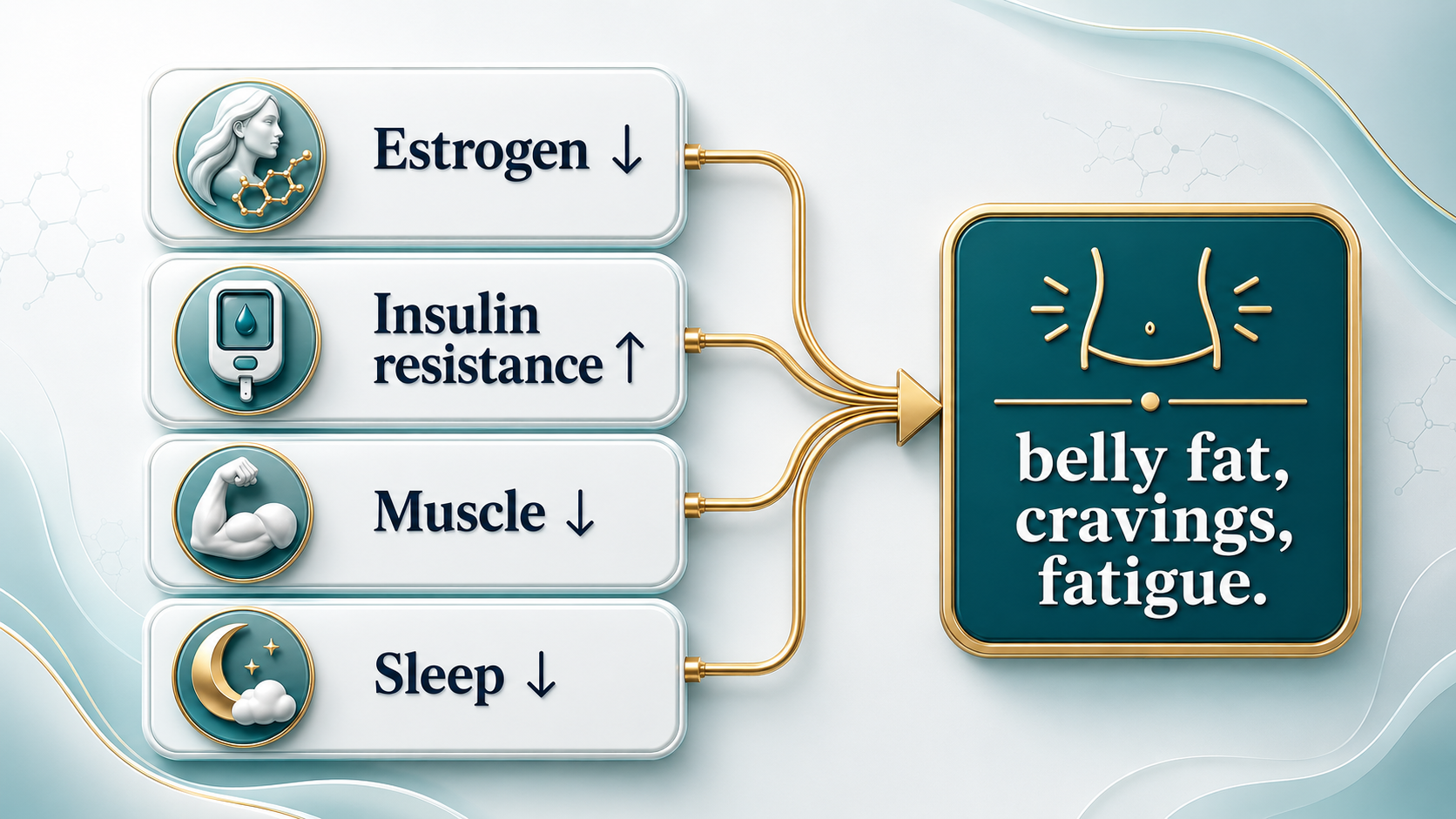
Four things move at once in perimenopause and menopause. Any one of them would slow you down. Together, they're why "eat less, move more" turned into a full‑time effort that produces almost nothing.
1. Estrogen stopped telling your fat where to live
For most of your life, estrogen helped park fat on your hips and thighs. As it declines, that storage pattern shifts toward your abdomen — the deep "visceral" fat around your organs. So the belly that appeared "out of nowhere" didn't move there to spite you. It moved because the hormone directing traffic clocked out. Visceral fat is also more metabolically active and tied to higher health risk, which is exactly why this is a medical conversation, not a vanity one.
2. Your body got more insulin resistant
Estrogen also helps your cells respond to insulin. As it drops, your body handles carbohydrates less efficiently — which means more is steered toward storage, blood sugar swings more, and cravings get louder right when you have the least patience for them. This is the engine behind the "I'm hungry all the time and it's always for bread" phase.
3. Muscle started leaving without permission
After your mid‑30s, muscle declines steadily, and the hormonal shift speeds it up. This matters more than almost anything else on this page: muscle is metabolically expensive — it burns energy even at rest. Lose it, and your resting metabolism drops, so the exact meals that maintained you at 35 now nudge the scale up at 48. You didn't start eating more. Your engine got smaller.
4. Sleep fell apart, and cortisol moved in
Hot flashes, night sweats, 3 a.m. staring contests with the ceiling. Poor sleep raises cortisol and scrambles the hormones that control hunger and fullness, so you wake up hungrier, reach for fast carbs, and store more of it as — you guessed it — belly fat. Exhausted, wired, and gaining weight is not a personal failing. It's a predictable chain reaction.
You keep saying "nothing changed." Everything changed. It just changed quietly, on the inside, where the scale couldn't see it.

Why your old diet quietly stopped working
Because it was solving the wrong problem.
Cutting calories harder doesn't replace lost estrogen, doesn't rebuild muscle, and doesn't fix insulin resistance. It usually makes two of those worse — under‑eating burns muscle and ramps up the cravings it was supposed to control. Eating 1,200 calories to fix a muscle‑and‑hormone problem is like bailing out a boat while drilling new holes in the bottom.
You were not failing the plan. The plan was failing your physiology.
So we stop dieting at your body and start working with it.
What actually works in midlife
No gimmicks, no detox, no fairy tales. Five levers, in roughly this order of impact:
Protein, on purpose. Most women in this phase eat far less protein than they need to hold onto muscle. Protein also keeps you full longer and blunts the blood‑sugar rollercoaster. The goal here is enough food built around protein — not restriction. If a plan's whole strategy is "eat less," that is not a plan.
Strength training — non‑negotiable. This is the closest thing we have to a longevity drug, and the only one you have to earn. Resistance training rebuilds the muscle that protects your metabolism, your blood sugar, your bones, and your independence later. Two or three honest sessions a week beats an hour of guilt‑cardio every time.
Sleep, treated like it matters. Because it does. We address the disruptors instead of pretending you'll just "get more rest" through willpower.
Stress and cortisol — realistically. I'm not going to tell you to do more yoga and manifest. We look at what's actually driving the cortisol load and what's changeable in your real life.
GLP‑1 medication, when it's the right tool. More on that next — because for a lot of women, this is the thing that finally makes the other four possible.
Where GLP‑1 fits (and where it doesn't)
If your hunger is biologically loud — constant food noise, evening snacking you can't out‑discipline, cravings tied to blood sugar swings — that's not weakness. That's the insulin‑and‑hormone shift talking. GLP‑1 medications like semaglutide and tirzepatide work by quieting appetite, improving blood sugar response, and interrupting the regain cycle. When they're appropriate, they can be the tool that finally makes protein, strength, and sleep doable instead of a daily fistfight.
Now the honest part: GLP‑1 is not magic, not for everyone, and not something I hand out like a coupon. It's a prescription medication with real risks, prescribed only after a full evaluation, when it's genuinely right for you — and always paired with the muscle‑and‑metabolism work, because a shot without strength training just makes you a smaller version of the same problem.
If medication isn't your tool, I'll tell you that too, and we'll go another way. That's the difference between care and a vending machine.
How I work with women in this phase
I'm Tatyana Kats, RN — 25 years in medicine, OB/GYN nursing experience, and advanced training in functional and integrative medicine and peptide education. My particular interest is exactly this window: perimenopause and menopause, when weight redistributes, cravings change, and energy drops "even though nothing else did."
What that means for you:
I look at the whole picture — hormones, thyroid, insulin, sleep, stress, muscle — not just a number on a scale or one lab out of context.
I treat you like an adult. You'll understand why we're doing what we're doing, in plain English, so you can make real decisions.
No fearmongering, no hype. Menopause is not a catastrophe and it's not a marketing opportunity. It's a phase with new rules, and I know the rules.
Telehealth across California, based in the San Francisco Bay Area — so distance isn't the thing that stops you.


-
Usually it's the hormones changing how your body handles what you eat — fat storage, insulin response, and muscle loss — more than a sudden jump in how much you eat. Most women in this phase swear "nothing changed," and they're right about their habits. What changed is internal. That's what we evaluate.
-
It's not a life sentence. Visceral belly fat is stubborn, but it also tends to respond well once you address the real drivers — insulin resistance, muscle loss, sleep, and, when appropriate, medication. "Harder than it used to be" is true. "Impossible" is not.
-
No. Perimenopause — the years before your periods stop, often starting in your 40s — is frequently when all of this begins, sometimes while your cycle still looks mostly normal. You don't have to wait until menopause is "official" to get help.
-
For many women, when it's medically appropriate and properly supervised, yes — but "appropriate" is decided by your history, your labs, and an evaluation, not by your age or a quiz. There are real contraindications, which is exactly why we screen before anything is prescribed. See whether you're a candidate.
-
Hormone therapy is a legitimate part of the midlife conversation for some women and not the right fit for others. It deserves a real, individualized discussion with a qualified clinician rather than a paragraph on a website. We can talk through whether it belongs in your picture at your consult, and coordinate care accordingly.
-
Only if the plan was a shortcut with no foundation. That's why muscle, protein, and habits aren't optional add‑ons here — they're what makes results hold. If medication is part of your plan, we also build a clear strategy for what happens when it's tapered, instead of leaving you to fall off a cliff.
Perimenopause weight loss: your questions, answered
Ready to stop fighting your own biology?
You can keep doing the thing that stopped working, or you can treat what actually changed. One of those comes with a clinician who'll tell you the truth.

This page is educational. It does not diagnose any condition, recommend a specific treatment for you, or guarantee results. GLP‑1 medications are prescription drugs with real risks and side effects, prescribed only after a full medical evaluation, when medically appropriate. Individual results vary. None of this replaces care from a clinician who has actually evaluated you — ideally me. Always consult a licensed provider before starting any treatment.